The Narrowest Waterway In The World Is Quietly Reshaping Global Business
A Strait Most People Never Think About, Until They Have To
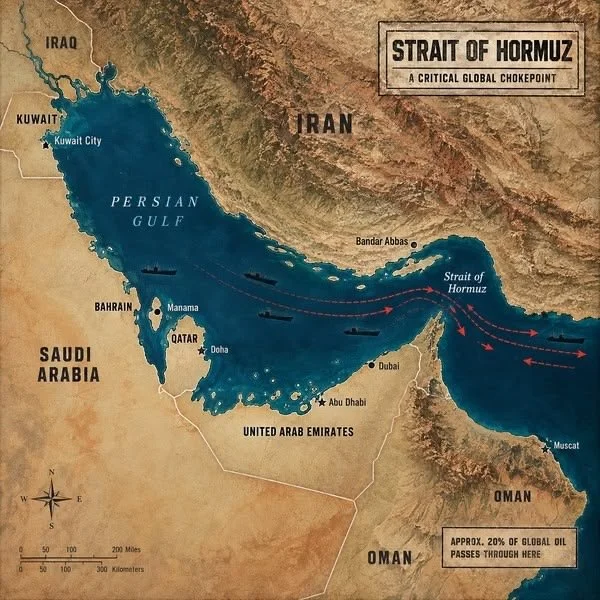
At its narrowest point, the Strait of Hormuz is barely 21 miles wide. For most of the world, it's a line on a map nobody ever needed to study closely. But for the global economy, it has functioned for decades as one of the single most important chokepoints on earth, the passage through which roughly a fifth of the world's oil and a fifth of its liquefied natural gas moved every single day before this year.
That was before. Since February 2026, following the outbreak of the US-Israel war on Iran, that waterway has become something else entirely, a live front line in a conflict that most of the world is watching unfold through fuel prices rather than headlines.
What's Actually Happening Right Now
Since the war began, Iran has laid sea mines, boarded and struck merchant vessels, and issued warnings restricting passage through the strait, particularly to any ship connected to the United States or Israel. The United States, in turn, has maintained a naval blockade against Iranian ports and conducted an aerial campaign against Iranian military targets along the waterway. By late August, US officials reported clearing over a hundred suspected mines from the strait's shipping lanes.
The two sides currently offer competing claims about who actually controls it. Washington insists the strait is open and that dozens of ships move through it daily. Independent shipping data tells a more complicated story, with traffic reportedly running roughly ninety percent below pre-conflict levels. As recently as this month, a commercial vessel was struck near Qeshm Island, and separate reports confirmed another vessel hit elsewhere in the strait, even as diplomatic talks between the US and Iran remain stalled. Iran has meanwhile moved to establish an alternative shipping arrangement with Oman, an apparent attempt to keep some maritime trade moving outside of US-monitored routes entirely.
Why This Matters Far Beyond The Middle East
This isn't a regional story anymore. It's a global supply chain story. Every business that touches shipping, fuel, manufacturing input costs, or logistics timelines has felt some version of this ripple, whether they've traced it back to its source or not. Energy markets have absorbed real shocks since February. Insurance premiums on vessels willing to transit the region have climbed sharply. Entire shipping routes have been quietly redrawn around a waterway that used to be simply assumed as open.
For anyone in commodities, trade facilitation, or cross-border logistics, this is a live reminder of something easy to forget in calmer years. Global trade doesn't run on abundance alone. It runs on a small number of physical chokepoints that, when contested, can reprice an entire global market within days.
What Scripture Says About Waters Like This
The Psalms describe something remarkably specific about people whose work depends on the sea. "Some went down to the sea in ships, doing business on the great waters; they saw the deeds of the Lord, his wondrous works in the deep." That psalm doesn't romanticize maritime trade. It acknowledges its real danger, describing storms that leave sailors reeling and afraid, and it credits God directly with calming what human skill alone could not.
There's something worth sitting with in that image right now. The people navigating the Strait of Hormuz today, seafarers, port workers, shipping companies, insurers, are living inside real, physical danger for the sake of goods the rest of the world depends on and rarely thinks about. Isaiah's words carry a different but related comfort for anyone watching this unfold from a distance with real anxiety about what it means for their own work or region. "When you pass through the waters, I will be with you, and through the rivers, they shall not overwhelm you." That promise was never only about literal water. But it isn't only metaphorical either, not for the actual seafarers whose lives are genuinely on the line in that strait today.
Holding This With Honest Perspective
It's worth saying plainly that this remains an active, unresolved, and genuinely uncertain situation. Analysts disagree about how long it continues, diplomats disagree about whether talks will resume, and even basic facts about current shipping volumes are disputed between the parties involved. Nobody watching this from outside the region should pretend to have more certainty than the people actually navigating it.
What can be said with confidence is this. The seafarers risking real danger to keep global trade moving deserve to be remembered as more than a line item in a shipping report. And for anyone in business whose work touches global supply chains, this moment is a sober, current reminder that resilience and diversification aren't abstract strategy exercises. They're the difference between a business that adapts when a chokepoint closes and one that simply stops.
Whatever side of this conflict anyone believes deserves the stronger case, the honest prayer for the people physically in that strait right now, sailors, port workers, and families waiting for them to come home, remains the same one the Psalms already gave us. That the deep would be crossed safely, and that the God who commands even the waters would be present in it.